The Farm massacre and Dinah's removal
Down Cemetery RoadThe Farm massacre and Dinah's removal reaches the reader not as a witnessed assault but as a trail of bodies, damage, and absence that Sarah Trafford and Zoë Boehm piece together on the island. Their search turns a remote farmhouse into evidence of lethal violence, and the discovery of a wounded woman and Dinah Singleton’s abandoned belongings leads Sarah to conclude that Michael Downey came in the night or early morning and took the child. The scene’s decisive change is both physical and moral: Dinah is gone, while Sarah’s understanding of the man who took her is violently unsettled.
The first signs of violence
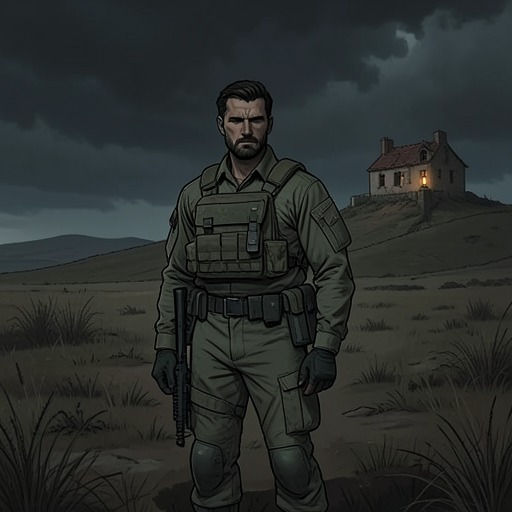
Twelve minutes after Sarah and Zoë set out, they find a body face-up just yards from what appears to be a farmhouse, an old stone bungalow built into a dip in the rock. The dead man is young, and an apple remains in his hand. Zoë judges that his death was violent, but does not turn the body over to confirm it; alone in the middle of nowhere, she has no wish to handle a corpse. Sarah calls it another body, though Zoë realizes she means the one in front of them. The exchange makes the discovery feel less like an isolated death than the first visible sign of a larger scene.
Zoë connects the body to Michael, and Sarah agrees only in a detached way. Concerned that Sarah might come apart, Zoë takes the small silver gun from her shoulder bag and asks whether Sarah wants to stay outside. Instead, Zoë leads the approach to the house. The island, quiet before the discovery, now seems filled with wind moving loose pebbles and tussock grass, and waves striking the rocky edges. Zoë briefly considers whether a shot might bring Jed back to collect them, but she is already pushing open the heavy wooden door. Her moment of imagined retreat gives way to entry before she can act on it.
Inside the farmhouse
The colder air inside offers no clear answer about whether the house is empty. In the kitchen, Zoë finds a dead man beside an oven and a sink still stacked with dirty dishes. A dark stain spreads across the blue cotton of his T-shirt, and she identifies him as having been shot. Her body begins to numb with shock and fear, while her thoughts remain practical: the man is dead, but neither she nor Sarah has been shot. That cold assessment registers how quickly the discovery has made survival the immediate measure of what is going well.
Sarah’s breathing catches behind Zoë, then releases; an angry, buzzing sound comes from somewhere overhead and fades. The upper floor yields no further bodies, living or dead. It contains two tidy, almost monastic-looking bedrooms and a living room with an uncomfortable, untidy sofa and an unswept fireplace. There is no sign of a child, and little evidence of settled life. The rooms suggest a temporary occupation, but cannot explain what happened or where Dinah is. Zoë hears no apparent sign of life below stairs, correcting herself inwardly: no one alive, perhaps. The distinction sharpens the dread as the search continues.
In the corridor downstairs, a wet, hiccuping sound comes from behind a closed door. Zoë’s reflex carries her toward it rather than away. She opens the nearest door and feels it stop against something soft and small; at first she thinks it may be another child’s body. Then movement to her left draws her attention to a woman curled against the wall. Zoë drops into a crouch, nearly forgets the gun in her hand, and then puts it back in her bag as she approaches. The woman is frightened and hurting, not dead. Zoë sees blood leaking from the woman’s hands, and concludes that she has been shot. The massacre is no longer only a set of bodies to be counted: someone has survived it, gravely injured and unable to explain what happened.
Dinah’s traces and Sarah’s conclusion
Sarah does not move the wounded woman; she does not know how to move her safely. As she looks around, she notices childlike pictures fixed to the walls with blu-tack: other children, animals, the sky, the sun, and a house. Each drawing gives the earth a strip of green at the bottom and the sky a strip of blue at the top. Sarah recognizes the room as belonging to Dinah. Nearby lies a large blue teddy bear, shot. Its damage makes the child’s absence more immediate: the room preserves traces of her, but she is not there.
Sarah infers that Michael came during the night or early morning, left the dead and wounded behind, and took Dinah. The wording of her conclusion matters: she supposes it was him. The scene gives her compelling signs, but its violence is discovered after the fact, not witnessed, and Sarah is still trying to fit what she sees to what she knows. She is surprised to find Michael fading in her memory, because the man she thought she knew no longer sits easily beside the apparent cause of this mayhem. Her revulsion is sharpened by their intimacy: she has lain with him, and now wonders whether she would have let him save her life if she had known what he was capable of.
The wounded woman and the aftermath
Sarah’s judgment remains incomplete. She recognizes that she barely understands the bond between Michael and Thomas Singleton, though she knows it was sealed in blood and could not be broken by less. She also recalls the painful complication that Maddy Singleton was married to Michael’s fellow soldier. These fragments do not explain the attack, but they prevent Sarah’s conclusion from becoming a simple account of motive. The violence is clear; the relationships that might illuminate it remain only partly legible to her.
With no other help to offer, Sarah goes to retrieve the bear. She fears that the woman may die in the moments she is away, yet the woman is still breathing when Sarah returns and kneels beside her with the ridiculous blue toy in her hands. The light in the woman’s eyes seems to flicker, though Sarah cannot tell whether that is truly happening or whether her own eyes are watering in the gloom. The bear is not a rescue and cannot undo what has happened; it is the one available gesture of care in a house marked by gunfire, absence, and helplessness. Zoë comes back upstairs, while the wounded woman speaks again. The search has located the massacre’s survivors and Dinah’s traces, but it has not recovered Dinah or established the full truth of Michael’s actions.